Minimum Energy Efficiency Standards For Commercial Property
As of 2026, the Minimum Energy Efficiency Standards (MEES) for

By the Simcott Renewables Strategy Team
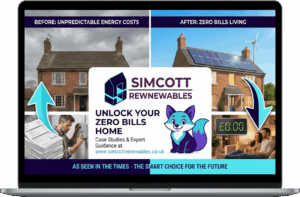
In a recent feature in The Times, a couple revealed the secret to their "Zero-Bill" home. They spent thousands on retrofitting insulation, solar panels, battery storage and of course the ever-contentious heat pump. To a pure "spreadsheet" economist, the payback period might look long. But to the homeowners there, the value was infinite.
As it has been said, “The opposite of a good idea can also be a good idea.” For homeowners the drive to have an energy efficient home is often framed through the narrow lens of "payback periods." But if we look at the behavioural science of The Times’ zero-bill home, we see a much more powerful narrative for our homes, energy independence: The move from being a consumer to being a producer.
Standard logic asks: "How much will this solar array save us per year?" Psycho-logic asks: "How much is it worth to never have to worry about a global energy crisis again?"
The family in The Times didn't just buy hardware; they bought certainty. When a Homeowner invests in Solar Panels and Battery Storage, they aren't just "buying panels." They are purchasing an insurance policy against the volatility of the Global Energy Markets, Wars and Political Turmoil. You are decoupling your homes energy needs, heating, lighting and cooking from the whims of global markets and large multinational energy companies with shareholder demanding ever increasing returns on investments.
There is a massive psychological difference between a "low bill" and a "zero bill." Zero is a magical number.
A project that reduces a homes energy bill by 80% is good. But a project that makes the building energy-positive—allowing the homeowner to sell power back to the grid or provide free EV charging is the holy grail. It transforms the homeowner from a "bill-payer" into a "clean energy generator and getting paid for the privilege."
Why do people buy expensive watches? They signal reliability and taste. Why should a homeowner engage in a “zero bills” renewable project? Because it signals to your community that everyone can make a difference to climate change everyday if they choose to.
The "Zero-Bill" home in The Times is a status symbol of the modern age. It is a "Green Signal" to the next generation, our children and grandchildren that we care about the world we leave them. It shows that the current political leadership that it isn't just managing decline; we the people care about the future of our plant and can do something about it and save thousands of pounds a year in the process.
Most homeowners suffer from the "Default Bias"—the idea that doing nothing is the safest path.
Its said that as humans we often fear the "risk of doing something" while ignoring the "risk of doing nothing." In the context of energy, "doing nothing" is a high-stakes gamble that energy prices will stay low forever. Spoilers: They won't.
By following the blueprint of the Times case study, Simcott Renewables helps homeowners flip the default. We make the transition to a zero bills home the "safe" choice for the homeowner’s long-term financial health, removing the cost of buying energy from the daily financial worries.
The family in The Times proved that the technology works. The financial logic is there. But the real win was the feeling of autonomy.
At Simcott Renewables, we don't just install solar panels. We help homeowners design Solar PV and Battery Storage systems for energy independence. We handle the "rational" stuff—the design, the DNO applications, the planning and can even help with the financing—so that you can focus on the win: Making your home the most resilient, forward-thinking, and energy-independent home in the county.
Are you ready to bring the "Zero-Bill" philosophy to your home Don’t ask for a quote. Ask for a vision.
As of 2026, the Minimum Energy Efficiency Standards (MEES) for
We specialise in helping manufacturers turn their idle roof space

As a landlord or property manager in Essex, staying ahead

UK business owners & directors have you asked your accounts
CATL — the world’s largest battery manufacturer — has officially

Ofgem has approved a £28 billion upgrade to rebuild the