Energy Bills After the Budget: What Comes Next?
Across the UK, households are bracing for another winter of

Thermify asks a simple question: what if that heat didn’t have to be wasted? What if the digital world’s exhaust could become our warmth?
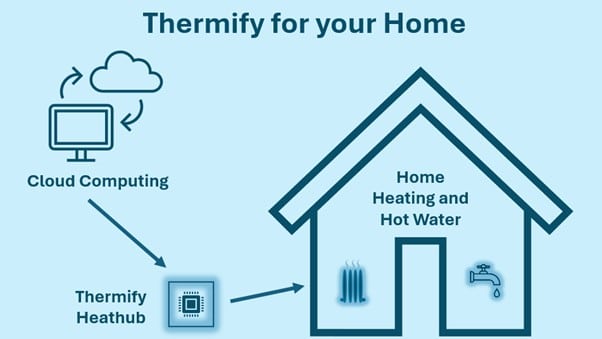
That’s the idea behind HeatHub, a system that takes the energy of cloud computing and turns it into home heating. The concept feels almost poetic: the cloud warming the home. But it’s also advanced engineering; clever, practical, and quietly radical.
The HeatHub works like this: cloud computing tasks are distributed across a network of compact computing modules. Each one performs real digital work for data clients. Instead of venting the by-product heat, Thermify captures it. That captured warmth is piped into a household heating and hot-water system.
Energy is used twice. First for computation, then for comfort.
In a world struggling to decarbonise heating, that matters. Gas boilers still warm most British homes. They are easy, familiar, yet polluting. The HeatHub is different, powered in part by renewable electricity and designed to reuse energy that would otherwise vanish into the air.
At Simcott Renewables, we see this as the start of something important. We’ve entered a strategic partnership with Thermify, becoming the company’s exclusive UK installation partner. Our job is to take this remarkable idea and make it work in real homes, to connect the promise of the technology with the reality of people’s lives.
“This partnership represents the kind of progress we need, practical, sustainable, and fair,” says Darran Ford, Director of Carbon Reduction at Simcott Renewables. “With Thermify’s technology, every bit of computing power contributes directly to household comfort. It’s an elegant example of how innovation can serve both people and the planet.”
This is not hype. It’s hard work, engineering, wiring, plumbing, integration, but it’s work that changes the story of energy from extraction to intelligence.
Thermify’s model belongs to a new category: heat as a service. It redefines ownership. Instead of every home burning its own gas, these systems become part of a shared digital-energy ecosystem. The computing work supports businesses; the by-product heat supports households.
For homes, that can mean lower bills and stable warmth, vital in a country where fuel poverty remains a real and rising problem. For the planet, it means lower emissions, up to 75 percent less carbon than conventional heating, according to Thermify’s data.
And for society, it shows what an inclusive Net Zero future could look like: one where technology and humanity align, and no energy goes to waste.
The UK’s path to Net Zero will not be driven by one single innovation, but by a network of them, smart, interconnected systems that make better use of what we already have. Thermify’s HeatHub is one of those ideas that bridges worlds: digital infrastructure meets domestic life; cloud meets kettle; computation meets compassion.
At Simcott Renewables, we believe in solutions that are both visionary and real. Thermify’s technology is both. It’s not about promises of a far-off future, it’s about how we heat our homes today, how we use energy intelligently, and how we make sure progress reaches everyone.
Warmth from data. Comfort from code. A small revolution, quietly humming in the corner of a home.
Across the UK, households are bracing for another winter of
The Autumn Budget brings a small dose of relief to
We are in the midst of an energy revolution but
We’re at a pivotal moment where energy is about more
In a world edging ever closer to net-zero deadlines, households

Batteries have come down in price significantly over the last